




/ICX_Insights%20content/Folder%20icon%20for%20insights.svg)
/ICX_Insights%20content/Folder%20celeste.svg)
/ICX_Insights%20content/Print%20gris.svg)
/ICX_Insights%20content/Print%20celeste.svg)
/ICX_Insights%20content/Share%20icon.svg)
/ICX_Insights%20content/Share%20celeste.svg)
/ICX_Insights%20content/Subscribe%20icon.svg)
/ICX_Insights%20content/Subscribe%20celeste.svg)
/ICX_Insights%20content/Start%20Here%20icon.svg)
/ICX_Insights%20content/Start%20here%20celeste.svg)
Design Thinking & Customer Experience Design
 Sergio Gutierrez : Jun 05, 2025
Nowadays, it has become a necessity to understand in depth what objectives customers are pursuing, what problems they face in their daily lives,...
5 min read
5 min read
Do you understand what the primary needs your customers seek to satisfy are? What is their objective, and what frustrates them in the process? Do you know how they perceive your brand? Beyond demographic data or basic satisfaction scores, few organizations can clearly answer these questions with evidence. Yet they are fundamental to designing value propositions, experiences, and services that truly resonate with the people you want to serve.
Customers do not interact with your company to “consume a process”; they do so to solve a problem, achieve a result, or move closer to a personal or business goal. Along the way, they encounter barriers, doubts, and emotions that can either strengthen or erode their relationship with your brand: confusion when information is not clear, mistrust when expectations are not met, frustration when they must repeat data, or relief and confidence when everything works smoothly and transparently.
If you want to understand how the users of your product or service feel and think—not as abstract “segments,” but as real people in concrete situations—this blog will be particularly useful. In the following sections, you will find a simple, structured tool that will help you:
- Visualize what your customers see, hear, say, do, think, and feel in a specific context.
- Identify what they truly value and what generates friction or dissatisfaction.
- Uncover implicit motivations, fears, and expectations that traditional surveys often fail to capture.
- Align your teams around a shared, evidence‑based understanding of the customer.
In short, this content will guide you step by step in using an empathy map, a practical instrument to empathize and put yourself in your customers’ shoes—so that every decision in product, service, and experience design is grounded in a deep understanding of their reality, and not in internal assumptions.
Index
An empathy map is a structured, visual representation of what a person thinks, feels, sees, hears, says, and does in a specific situation. Rather than describing the customer only through demographic data or generic labels, the empathy map helps teams capture the internal world of the user—their motivations, fears, expectations, and frustrations—in relation to a product, service, or experience. Used correctly, it becomes a bridge between quantitative data (what users do) and qualitative insights (why they do it).
On a single canvas, multidisciplinary teams can consolidate findings from interviews, surveys, behavioral analytics, and observation, organizing them into intuitive quadrants. This facilitates a richer conversation about the customer, reveals patterns that are not obvious in raw data, and exposes assumptions or biases that may be driving internal decisions. For organizations that want to design customer‑centric strategies, the empathy map is a practical starting point: it enables product, marketing, operations, and Customer Experience teams to align around a common understanding of the user, prioritize opportunities based on real pain points and desires, and make better decisions about propositions, journeys, and experiences that truly resonate with the people they serve.
Most companies lack real visibility into their customer journey.


If we take the Design Thinking methodology as a reference, empathy is the first stage of the process; this is crucial to understand the user, their needs, desires, and pain points so that we can visualize the world through the eyes of the customer. Precisely, the empathy map is a tool used in this methodology in the second stage called "definition," helping to summarize the findings of the first phase.
In other words, the empathy map allows us to capture in a simple way the frustrations, feelings, and perceptions of the Buyer Persona, validated through data analysis.
The empathy map was created by Dave Gray, founder of XPLANE, as a practical response to a recurring challenge in innovation and design projects: teams had a great deal of fragmented information about their users, but lacked a simple, shared way to visualize and discuss it. Gray introduced the tool in an initial version of the book “Game Storming,” positioning it as a collaborative canvas to quickly align diverse stakeholders around a common understanding of the customer.
In its first visualization, the empathy map presented the user at the center and organized insights around a set of key dimensions that describe their experience and internal world. These original elements were:
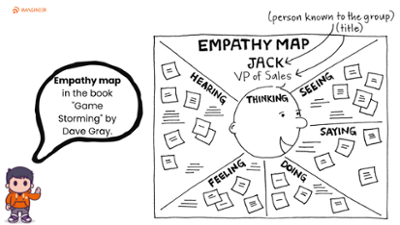
However, the map was eventually redesigned to arrive at a complete version:
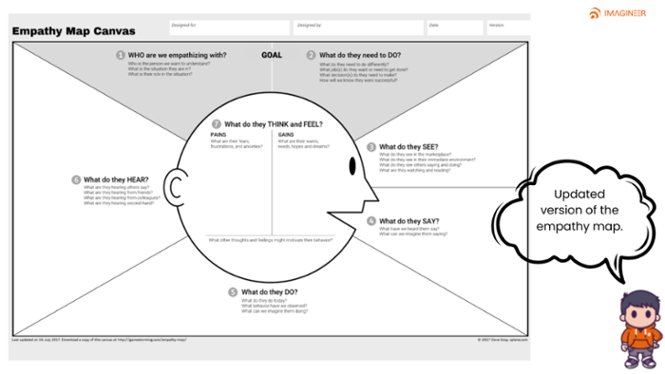
Although we might think that building the empathy map is just a matter of taking the template and starting to fill it in, in reality, it is necessary to carry out a series of steps that ensure the result is rigorous, useful, and truly representative of the user. If we skip these steps, the map ends up reflecting internal opinions instead of real customer insights, and quickly loses value as a decision‑making tool.
Before writing anything on the canvas, it is essential to define what experience, segment, and context we want to analyze, what business questions we need to answer, and what decisions the map will inform. It is also critical to collect and synthesize evidence from different sources—interviews, surveys, analytics, observation—so that each post‑it on the map is backed by data and not by assumptions. Only after this preparatory work does it make sense to collaboratively complete the quadrants, analyze relationships and tensions between what the user thinks, feels, says, and does, and finally derive insights, opportunities, and hypotheses to guide the design of value propositions, journeys, and improvements in the customer experience.
Define the scope and goal
Conducting the relevant research (data collection)
Fill in the empathy map (there is no particular order)
Analyze the quadrant data (to find the opportunities)
Identify user needs (Maslow's pyramid)
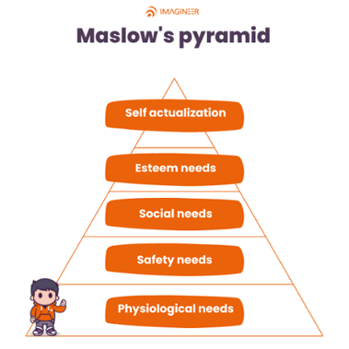
In conclusion, the empathy map helps companies understand their customers’ needs and wants in a deeper, more human way. It goes beyond traditional segmentation and static profiles, revealing what people are actually trying to achieve, what they fear, what frustrates them, and what they expect from a brand at each moment of the relationship.
It is a simple yet powerful technique with which you can systematically identify customers’ pain points, emotional triggers, and moments of truth, and then translate those insights into concrete actions: improved processes, clearer communications, more relevant value propositions, and experiences that remove friction instead of adding it. Used consistently, the empathy map becomes a practical input for designing products, services, journeys, and support models that are truly aligned with how customers think and feel.
If you want to build trust and provide a good customer experience, the starting point is to understand your customers’ pain points and aspirations with evidence, not assumptions. Doing so allows you to offer solutions that make them feel listened to, valued, and understood, strengthening the relationship over time. For leadership teams, incorporating empathy maps into strategic discussions also creates a shared language around the customer, helping to align priorities, justify investments in CX, and ensure that business decisions are grounded in what really matters: the experience people have with your brand.
Do you really know what's going wrong with your customer experience?


Sergio Gutierrez : Jun 05, 2025
Nowadays, it has become a necessity to understand in depth what objectives customers are pursuing, what problems they face in their daily lives,...

 Aileen Pierce : May 29, 2025
In today's highly competitive market, people have a wide variety of brands or entities to turn to when they need a product or service. For a company...

The Customer Journey is the complete path that a customer follows in their relationship with a company, from the very first contact or interaction...


