




/ICX_Insights%20content/Folder%20icon%20for%20insights.svg)
/ICX_Insights%20content/Folder%20celeste.svg)
/ICX_Insights%20content/Print%20gris.svg)
/ICX_Insights%20content/Print%20celeste.svg)
/ICX_Insights%20content/Share%20icon.svg)
/ICX_Insights%20content/Share%20celeste.svg)
/ICX_Insights%20content/Subscribe%20icon.svg)
/ICX_Insights%20content/Subscribe%20celeste.svg)
/ICX_Insights%20content/Start%20Here%20icon.svg)
/ICX_Insights%20content/Start%20here%20celeste.svg)
Types of Magento integration with my inventory system
Pricing rules help to attract new customers to our site by encouraging them to buy our products.
7 min read
7 min read
Artificial intelligence is already inside companies, even if many still don’t want to see it that way. Not as a formal project, but as fragments: a chatbot here, a scoring model there, a marketing automation, some attempt in operations or finance. The problem is not that AI is absent. The problem is that it appears on top of structures that are not ready to support it.
And that’s where the errors begin.
People talk about automating decisions, implementing predictive models, using copilots in sales or service. But when you zoom into operations, you find something else: duplicated data, systems that don’t talk to each other, teams working outside the CRM, reports that don’t match across areas. In that context, AI is not a solution. It’s an amplifier of disorder.
That’s why AI governance conversations usually start on the wrong foot. They focus on models, risks, regulation. But governance doesn’t start there. It starts much earlier, in something less attractive but far more decisive: how the operation is built.
Governing AI is not about defining rules for algorithms. It’s about making sure the organization can sustain automated decisions without losing control, without losing visibility, and without breaking consistency as it scales.
There’s an idea that needs to be clear from the start: artificial intelligence doesn’t run on intention; it runs on structure. It doesn’t matter how sophisticated the model is if the foundation it operates on is fragmented.
Many organizations try to start at the end. They want smart segmentation, automatic prioritization, churn predictions, or real-time recommendations. But they haven’t yet resolved something more basic: where their data lives, how it connects, who maintains it, and how reliable it is.
In practice, this error shows up in very concrete ways:
- Different areas managing different versions of the same customer
- Commercial metrics that don’t match what finance reports
- Automations that depend on incomplete data
- Models that don’t inspire trust in the teams
The outcome is predictable: models that don’t convince, automations that break, teams that stop trusting. And then comes the wrong conclusion: “AI is not ready.” When in reality, it’s the business that isn’t ready.
That’s why it’s more useful to think of AI governance as an operational maturity process. Not as a technical checklist, but as a logical evolution that goes from data control to the ability to scale intelligent decisions.

Everything starts here, even if it’s not the most exciting topic to discuss.
Control is not about security or compliance. It’s about mastery. Knowing exactly what data exists, where it is, who generates it, and what the single source of truth is.
In most companies, information is distributed across multiple systems. The CRM contains commercial relationships, the ERP manages transactions, eCommerce records purchase behavior, the WMS controls inventory, and marketing platforms capture digital interactions. Each one works relatively well on its own, but the problem appears when you try to build a unified view.
Without integration, each system tells a different story.
And this is not a minor issue. This disorder translates into:
- Duplicated or poorly identified customers
- Orders not correctly linked to the customer
- Incomplete interaction history
- Difficulty segmenting or analyzing behavior
This is where governance starts to take shape through concrete decisions:
- Defining which system is the source of truth by data type
- Standardizing unique identifiers (customer, order, product)
- Cleaning historical data before automating
- Ensuring consistent integrations (APIs, middleware, tools like Zapier)
This directly involves real tools: HubSpot or Salesforce on the commercial layer, SAP or other ERPs on the transactional layer, Magento or Adobe Commerce on the digital layer. But technology alone doesn’t solve this. It’s a structural decision.
Without this level, AI has no context. It has data, but it doesn’t know what it means.
Once data is under control, the next problem appears: understanding what is really happening.
Many organizations believe they’ve already solved this because they have dashboards. But seeing metrics is not the same as having traceability. Reports show results. Traceability explains processes.
In a mature operation, you should be able to reconstruct the complete history of any customer, order, or interaction. Know where it came from, which steps it went through, where it stalled, what decisions were made, and which systems were involved.
When this doesn’t exist, very clear symptoms appear:
- You can’t explain why an opportunity was lost
- You don’t understand the origin of a variation in sales or margin
- Customer service lacks context about what happened before
- Marketing doesn’t know which actions actually drive conversion
Traceability connects everything.
It allows you, for example, to follow an end-to-end flow:
- A user comes in through a digital channel
- Becomes a lead
- Moves to opportunity in the CRM
- Generates a purchase in eCommerce
- Is invoiced in the ERP
- Is delivered through the logistics system
When this is connected, data stops being isolated records and becomes a story.
And that completely changes the game for AI.
Because any model needs context. Without traceability, AI learns from fragments. And when it learns from fragments, its decisions are fragmented too.
Here, governance translates into:
- Complete event history
- Consistent integrations between systems
- Ability to audit decisions
- Cross-business visibility
It’s not sophistication. It’s clarity.

Everything starts here, even if it’s not the most exciting topic to discuss.
Control is not about security or compliance. It’s about mastery. Knowing exactly what data exists, where it is, who generates it, and what the single source of truth is.
In most companies, information is distributed across multiple systems. The CRM contains commercial relationships, the ERP manages transactions, eCommerce records purchase behavior, the WMS controls inventory, and marketing platforms capture digital interactions. Each one works relatively well on its own, but the problem appears when you try to build a unified view.
Without integration, each system tells a different story.
And this is not a minor issue. This disorder translates into:
- Duplicated or poorly identified customers
- Orders not correctly linked to the customer
- Incomplete interaction history
- Difficulty segmenting or analyzing behavior
This is where governance starts to take shape through concrete decisions:
- Defining which system is the source of truth by data type
- Standardizing unique identifiers (customer, order, product)
- Cleaning historical data before automating
- Ensuring consistent integrations (APIs, middleware, tools like Zapier)
This directly involves real tools: HubSpot or Salesforce on the commercial layer, SAP or other ERPs on the transactional layer, Magento or Adobe Commerce on the digital layer. But technology alone doesn’t solve this. It’s a structural decision.
Without this level, AI has no context. It has data, but it doesn’t know what it means.
Traceability: when the business stops being a black box
Once data is under control, the next problem appears: understanding what is really happening.
Many organizations believe they’ve already solved this because they have dashboards. But seeing metrics is not the same as having traceability. Reports show results. Traceability explains processes.
In a mature operation, you should be able to reconstruct the complete history of any customer, order, or interaction. Know where it came from, which steps it went through, where it stalled, what decisions were made, and which systems were involved.
When this doesn’t exist, very clear symptoms appear:
- You can’t explain why an opportunity was lost
- You don’t understand the origin of a variation in sales or margin
- Customer service lacks context about what happened before
- Marketing doesn’t know which actions actually drive conversion
Traceability connects everything.
It allows you, for example, to follow an end-to-end flow:
- A user comes in through a digital channel
- Becomes a lead
- Moves to opportunity in the CRM
- Generates a purchase in eCommerce
- Is invoiced in the ERP
- Is delivered through the logistics system
When this is connected, data stops being isolated records and becomes a story.
And that completely changes the game for AI.
Because any model needs context. Without traceability, AI learns from fragments. And when it learns from fragments, its decisions are fragmented too.
Here, governance translates into:
- Complete event history
- Consistent integrations between systems
- Ability to audit decisions
- Cross-business visibility
It’s not sophistication. It’s clarity.
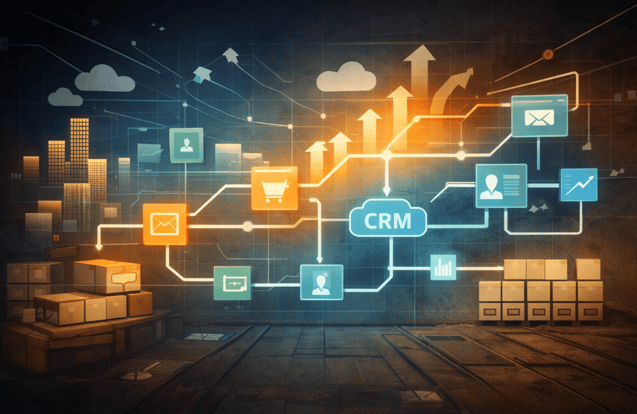
Companies that manage to capture real value from AI share one thing in common: their operation is aligned. Data is connected, processes are traceable, and teams work inside the system.
When that happens, AI is not a leap. It’s a consequence.
The governance of artificial intelligence should not be understood as an extra layer of control imposed at the end of the road, nor as an isolated regulatory exercise to calm the organization while it adopts new tools. In reality, it is much more than that. It is the way a company prepares itself so that artificial intelligence can generate real value without disrupting operations, without weakening the quality of decisions, and without amplifying the errors that already existed in its structure.
That is the most important point in this entire discussion. AI does not arrive to fix a fragmented business. It does not replace poorly designed processes. It does not magically solve adoption, traceability, or data quality problems. What it does is expose, at greater speed and scale, what the organization already was. If the foundation is solid, artificial intelligence accelerates, optimizes, and multiplies value. If the foundation is weak, it accelerates confusion, inconsistencies, and unreliable decisions.
That’s why, when we talk about control, traceability, and scalability, we are not just referring to three attractive concepts to structure a technology conversation. We are talking about three capabilities that reflect the real level of maturity of a company. Control shows whether the organization truly masters its information or merely coexists with it. Traceability reveals whether there is enough visibility to understand what happens across systems, areas, and process steps. And scalability shows whether the operation has the discipline needed to grow without breaking itself in the process.
From that perspective, governing AI is not just a matter of technology, innovation, or compliance. It is a business conversation. It involves how data is structured, how systems are connected, the role people play in recording information, and the company’s ability to turn all of that into smarter, faster, and more sustainable decisions. It is not about having more tools. It is about building an environment where those tools can operate meaningfully.
Organizations that understand this in time will stop chasing artificial intelligence as a fad or as an abstract promise of efficiency. They will start seeing it for what it really is: a capability that only creates advantage when it rests on a coherent operation. That is the difference between a company that simply “uses AI” and a company that is truly prepared to integrate it as part of its operating model.
In the end, the key question is not who has access to the best model, who implemented a copilot first, or who automated part of the process faster. The real question is much more uncomfortable and much more strategic: do we have the structure required for artificial intelligence to operate in a reliable, explainable, and scalable way within our business?
Because AI is not the beginning of operational maturity or digital transformation . It is their natural consequence. It arrives when the organization has already organized its data, defined its critical processes, aligned its teams, and turned technology into a consistent extension of its management model, rather than a collection of isolated initiatives.
Only when an organization understands this does the conversation stop being merely technological—focused on tools, vendors, or specific features—and become a truly strategic conversation about digital transformation: what business model it wants to build, which decisions it needs to automate with confidence, which capabilities it must develop to scale, and how AI fits into that journey as an accelerator, not as a shortcut.


Pricing rules help to attract new customers to our site by encouraging them to buy our products.

 Meicel Valverde : May 29, 2025
Magento is a very robust platform that has different modules, adaptable to industries such as retail, insurance, hotel sector, even for the financial...

 Esteban Cordero : May 29, 2025
We are no longer in an economy of products, we are in an economy of experiences, increasingly accelerated by a digital and technological revolution,...

