




/ICX_Insights%20content/Folder%20icon%20for%20insights.svg)
/ICX_Insights%20content/Folder%20celeste.svg)
/ICX_Insights%20content/Print%20gris.svg)
/ICX_Insights%20content/Print%20celeste.svg)
/ICX_Insights%20content/Share%20icon.svg)
/ICX_Insights%20content/Share%20celeste.svg)
/ICX_Insights%20content/Subscribe%20icon.svg)
/ICX_Insights%20content/Subscribe%20celeste.svg)
/ICX_Insights%20content/Start%20Here%20icon.svg)
/ICX_Insights%20content/Start%20here%20celeste.svg)
Making the Voice of the Customer count
 Adrian Ureña Moraga : Aug 22, 2025
Understanding the Voice of the Customer (VoC) isn’t just about listening to feedback—it’s about embedding customer perspectives into every business...
8 min read
8 min read
In today’s increasingly competitive business environment, the ability to listen to and understand customers has become a critical factor for success. Voice of the Customer (VOC) is a methodology that allows organizations to capture, analyze, and act on their customers’ needs, expectations, and concerns. It’s not just about gathering information, but about turning those insights into specific actions that optimize the customer experience and ultimately drive business growth.
Implementing a VOC strategy goes beyond conducting surveys or monitoring social media. It is a structured process that requires planning, the right tools, and organizational commitment to respond to the insights obtained. When executed properly, VOC can become a competitive advantage, enabling companies to anticipate market demands and strengthen customer loyalty.
In this article, we will explore the fundamental steps for successfully implementing a Voice of the Customer strategy, the most common challenges, and the best approaches to ensure that collected data translates into tangible results.
Voice of the Customer (VOC) is a systematic process that enables organizations to gather and analyze customer perspectives, needs, and aspirations. Unlike traditional satisfaction surveys, which are often one-off and limited, VOC seeks to capture a holistic view of the customer through multiple sources of both qualitative and quantitative information.
The primary goal of VOC is to understand not just what customers say, but what they truly need and desire. This means looking beyond surface-level complaints or praise to detect trends, patterns, and opportunities for improvement. For example, a customer might complain about a slow checkout process, yet the underlying issue could actually be an unintuitive digital platform or inadequate customer service.
VOC is about more than listening—it’s about understanding, prioritizing, and taking action. It’s a powerful tool for aligning company efforts with customer expectations, resulting in higher satisfaction, loyalty, and financial performance.
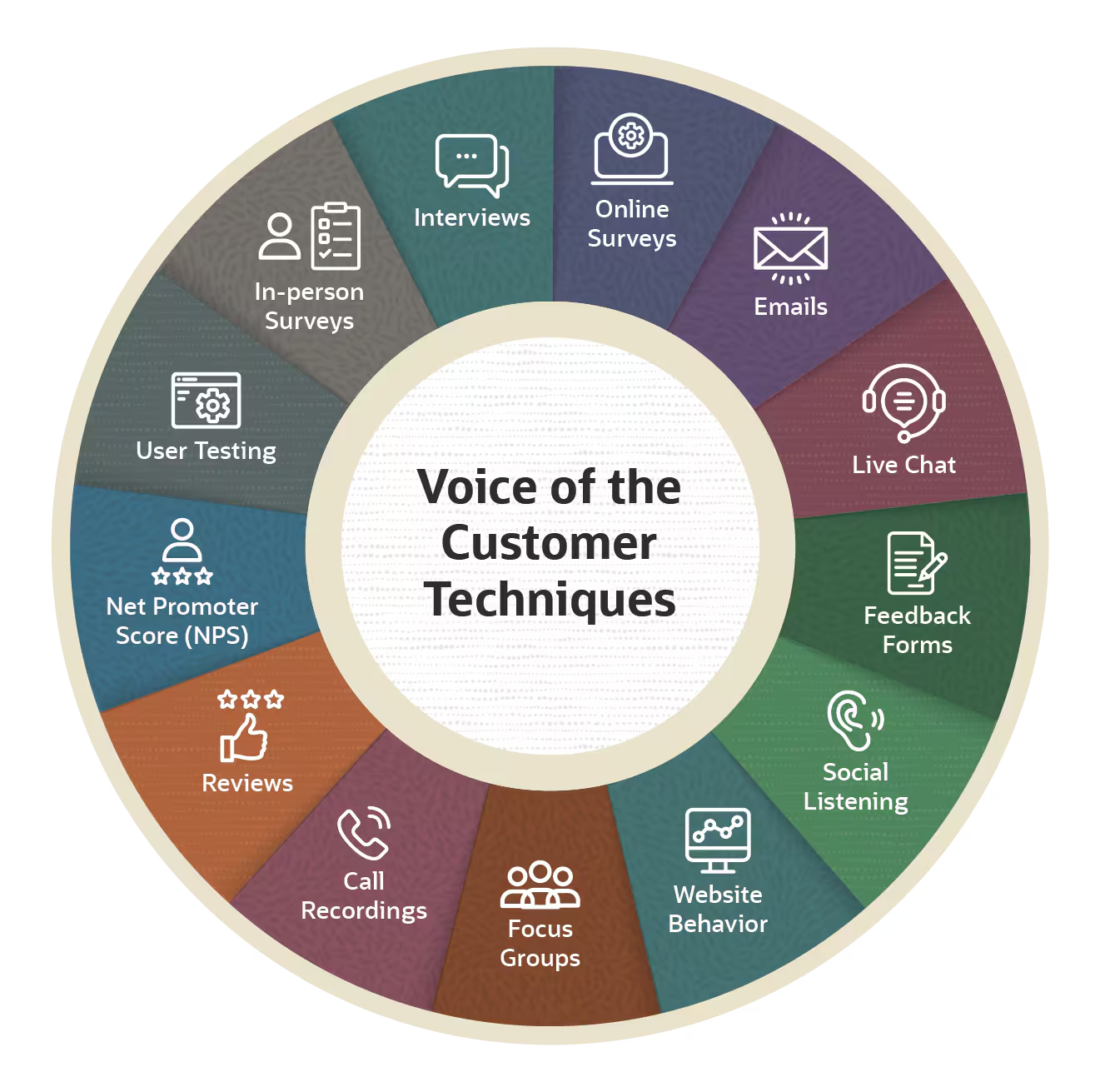
There are various techniques for capturing Voice of the Customer, each with specific advantages and applications. For example, focus groups can be blinded (conducted by a third party without revealing the company’s identity) or unblinded (organized directly by the company), delivering deep, detailed insights into customer perceptions. Another effective technique is recorded phone interviews, such as those facilitated by companies like InVibe for fast, direct communication. Additionally, surveys via platforms like SurveyMonkey offer a scalable way to gather feedback. Social media platforms such as LinkedIn and Twitter, along with analysis of website behavior, help clarify how customers interact with and what they seek from the brand. Finally, methods like conjoint/trade-off analysis reveal what customers are willing to give up for a lower price or better features. Despite the range of available tools, many companies don’t fully leverage these techniques. Implementing a VOC strategy keeps organizations aligned with both critical and non-critical customer needs—which can make the difference in the market.
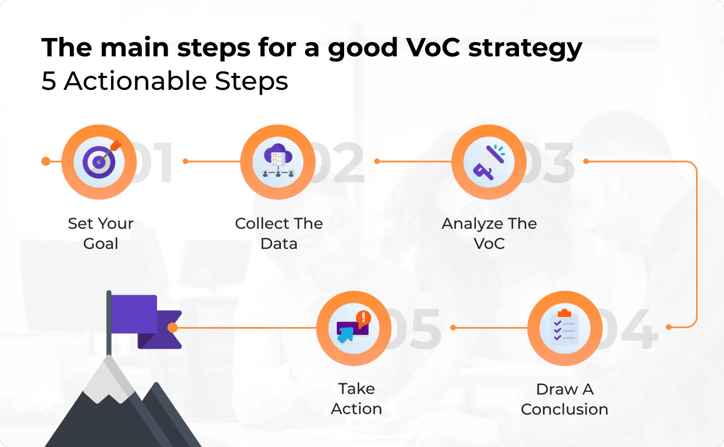
The first step in implementing a VOC strategy is to clearly define what you want to achieve. Are you looking to improve customer experience, reduce churn, innovate in products or services, or simply gain a better understanding of your target market? Setting clear and measurable objectives is essential to guide the process and gauge its success.
For example, a retail company might set a goal to reduce delivery time complaints by 20% over the next six months. This objective is not only specific but also enables you to measure the impact of the actions taken.
VOC draws on multiple information sources, both internal and external. Some of the most common include:
- Surveys and interviews: Traditional tools for obtaining direct customer feedback.
- Social media: Platforms like Twitter, Facebook, or Instagram are rich in spontaneous comments and opinions.
- Online reviews: Sites such as Google Reviews, Yelp, or Amazon provide valuable insights about customer perceptions.
- Internal data: Information collected by sales, technical support, or customer service teams.
It’s important to diversify data sources to get a complete picture and avoid bias. For instance, surveys can provide structured data, while social networks offer more spontaneous and emotional insights.
Once data sources have been identified, the next step is to collect and analyze the information effectively. This process isn’t just about gathering large volumes of data, but about transforming it into actionable insights for informed decision-making. Here are some best practices:
Not all customers are the same, and their feedback should be analyzed using specific criteria to identify relevant trends and patterns. Segmentation allows you to group feedback by demographics (age, gender, location), product lines, purchase channels, or any other meaningful criteria for your business. For example, if a tech company receives complaints about a particular product, segmenting comments by region could reveal if the issue is related to local logistics or to the product itself.
Sentiment analysis is a powerful technique that uses Natural Language Processing (NLP) to determine the tone and emotions expressed in customer comments. This tool classifies feedback as positive, negative, or neutral, helping you identify urgent improvement needs or aspects that are working well. For example, if sentiment analysis reveals that 80% of the feedback on a new service is negative, this is a clear sign that swift intervention is needed.
Text analysis takes it a step further by identifying common topics, keywords, and recurring phrases in customer comments. This technique uncovers patterns that may not be immediately obvious. For example, if multiple customers mention “long wait times,” it likely signals a recurring issue that must be addressed. Tools like Salesforce Feedback Management make this process easier by integrating text analysis directly into the CRM, enabling teams to act quickly on acquired insights.
To contextualize VOC data, it’s useful to compare it with both internal and external benchmarks. Benchmarking helps you evaluate how your company is performing compared to competitors and to your own history. For instance, if your customer satisfaction index has dropped by 10% over the previous year, this could indicate a systemic problem that requires immediate attention. Additionally, comparing your metrics with industry standards helps identify areas for competitive improvement.
Data visualization is essential for presenting VOC analysis results in a clear, understandable way. Leveraging interactive dashboards, charts, and tables enables teams to quickly grasp trends and make informed decisions. For example, a bar chart displaying top customer complaints by category can help prioritize areas for improvement. Tools like Tableau or Power BI are excellent choices for creating impactful visual reports.
Platforms such as Salesforce Feedback Management provide a comprehensive solution for analyzing VOC data directly within the CRM. This not only streamlines the analysis process, but also allows teams to take immediate action based on the insights obtained. For instance, if a customer expresses dissatisfaction with a product in a survey, the sales or support team can proactively contact them to resolve the issue, thereby improving the customer experience.
A well-executed analysis of customer feedback not only identifies problems, but also reveals opportunities for improvement and innovation. By segmenting data, applying sentiment and text analysis, performing benchmarking, and leveraging visualization tools, companies can transform feedback into concrete actions that drive customer satisfaction and business growth.
Not every insight will have the same impact. That’s why it’s essential to prioritize improvement areas according to their relevance and feasibility. For example, if data shows that 70% of complaints are related to delivery service, this should be the main focus.
Prioritization also involves engaging various departments across the company. A problem identified through VOC may require collaboration among logistics, technology, or marketing teams to be resolved effectively.
The final step is to translate insights into concrete actions. This could involve anything from product or service improvements to internal process changes or shifts in communication strategies. It’s crucial to establish metrics to measure the impact of these actions, such as increases in customer satisfaction, reductions in complaints, or sales growth.
Implementing a Voice of the Customer (VOC) strategy comes with its own set of challenges. Here are some of the most frequent hurdles businesses face—along with practical solutions to overcome them:
Low response rates: One of the most common issues is the difficulty in obtaining sufficient customer feedback. Low response rates can undermine the effectiveness of a VOC program, as the data collected may not be representative.
Solution: To encourage participation, it’s crucial to make the feedback process quick, easy, and convenient. Personalizing feedback requests, offering incentives (such as discounts or gifts), and using customers’ preferred channels—like brief text messages or emails—can significantly increase response rates.
Data overload: Gathering large volumes of feedback can be overwhelming, especially if the right tools for processing and analyzing information are missing.
Solution: Leveraging advanced analytics tools, such as natural language processing (NLP) software or feedback management platforms like Salesforce, can automate analysis and efficiently extract key insights. Additionally, focusing on the most relevant data and segmenting it appropriately helps direct efforts where they matter most.
Organizational silos: A lack of communication between departments can prevent customer feedback from being shared and acted on effectively. Silos cause duplicated efforts and deliver inconsistent responses.
Solution: Centralizing VOC data in a CRM or collaborative platform ensures all teams can access the same information in real time. Tools like Slack or Microsoft Teams can also streamline cross-team collaboration, ensuring insights lead to coordinated action.
Lack of action: Collecting feedback without following up with concrete actions is one of the most serious mistakes in any VOC program. This not only wastes resources but can also cause frustration among customers who expect improvements based on their input.
Solution: Develop clear action plans and assign specific responsibilities. It’s also important to keep customers informed about changes made in response to their feedback. This not only improves customer satisfaction but also fosters a culture of trust and transparency.
Bias in data collection and analysis: Bias, whether during data collection or analysis, can distort results and lead to incorrect conclusions. For example, gathering feedback from only one customer segment means the resulting insights won’t be representative.
Solution: Use a variety of channels to reach a broad range of customers and apply analytical methods like random sampling or cross-validation to minimize bias. In addition, training team members to recognize and mitigate unconscious bias during data collection and analysis is essential to ensure objectivity.
For a Voice of the Customer (VOC) strategy to be truly effective, it’s essential to take a holistic approach that involves the entire organization and leverages the right tools. First, engaging every level of the company—from senior leadership to operational teams—is critical. When leaders demonstrate genuine commitment to active listening, it sends a clear message across the organization: the customer is at the center of everything we do. This commitment not only facilitates resource allocation but also fosters a culture of continuous improvement.
Additionally, implementing the right technology can simplify and optimize the process of data collection and analysis. Tools like CRM platforms or text analytics software help automate tasks, identify patterns, and efficiently extract insights. These solutions not only save time, but also ensure that data gets turned into tangible, measurable actions.
Another core pillar is building a continuous feedback loop. VOC is not a one-off project—it’s an iterative process that requires constant listening, action, measurement, and improvement. This approach ensures that customer feedback doesn’t just sit unused but actually delivers tangible changes that positively impact their experience.
Finally, fostering a customer-centric culture is vital for long-term success. Everyone in the organization, regardless of their role, should understand the significance of VOC and how their work contributes to meeting customer needs. When this mindset is ingrained in the company culture, VOC becomes not just an isolated initiative, but an integral part of the business strategy.
Amazon is a prime example of how Voice of the Customer (VOC) can drive continuous improvement and innovation. The company systematically uses customer reviews and feedback to identify usability issues and make adjustments to its platform and services. This approach has been key in maintaining its market leadership and delivering an exceptional shopping experience.
>> How Amazon Uses Customer Feedback to Improve <<
Starbucks is another noteworthy case in successful VOC implementation. The company has harnessed customer feedback to make changes to its menu—like adding healthier and more customizable options—and to optimize its loyalty program. These actions have resulted in significantly higher customer satisfaction and loyalty.
My Starbucks Idea
Implementing a Voice of the Customer (VOC) strategy is no simple task, but its benefits more than justify the effort. By actively listening to customers and acting on their needs, companies can enhance the customer experience, drive loyalty, and ultimately accelerate business growth.
The key to success lies in careful planning, using the right tools, and full organizational commitment. It’s not just about gathering data; it’s about turning those insights into concrete actions that have real impact.
In a world where customer experience is a key differentiator, VOC has become an indispensable tool for any business seeking to remain competitive. Are you ready to listen to your customers and take your business to the next level? At ICX, we can help!


Adrian Ureña Moraga : Aug 22, 2025
Understanding the Voice of the Customer (VoC) isn’t just about listening to feedback—it’s about embedding customer perspectives into every business...

In an increasingly competitive marketplace, understanding your customers is not just an advantage—it’s a necessity.

 Aileen Pierce : Jun 05, 2025
In today's competitive landscape, delivering an exceptional customer experience requires more than just understanding customer needs—it demands a...


